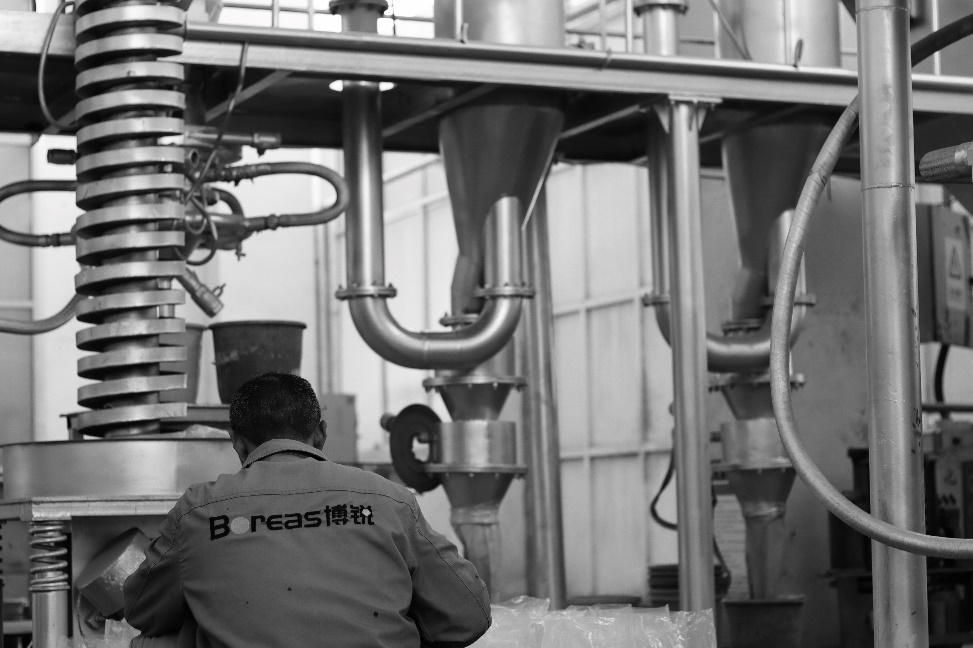


Diamond Micron Powder:Jet Milling and Precision Classification by Boreas
Diamond is a mineral composed entirely of pure carbon, known for its exceptional hardness and wear resistance. It is widely used in cutting, grinding, and polishing applications for hard-to-machine materials such as ceramics, semiconductors, sapphire, and advanced alloys.
Once scientists discovered that diamond and graphite are allotropes of carbon, the development of synthetic diamond became a major milestone in materials science. Today, synthetic Diamond Powders play a critical role in high-precision manufacturing industries.
Evolution of Diamond Micron Powder
Diamond micron powder is available in multiple size ranges, including:
- Micron scale (µm)
- Sub-micron scale
- Nano scale
As particle size decreases, diamond powders exhibit significant changes in physical and chemical properties:
- Increased specific surface area
- More active surface functional groups
- Reduced internal crystal defects
- Improved particle strength and stability
The production of diamond micron powder is not simply a size reduction process. It also involves changes in crystal integrity, surface chemistry, and mechanical performance, all of which directly influence polishing efficiency and surface quality.
Demand for High-Precision Surface Finishing
With the rapid development of advanced manufacturing industries such as semiconductors, optics, aerospace, and precision ceramics, surface quality requirements have become increasingly strict.
Even microscopic scratches or surface defects beyond allowable tolerance can lead to:
- Reduced component performance
- Lower product reliability
- Failure in high-precision assemblies
As a result, ultra-Fine Diamond Powders have become essential consumables for precision lapping and polishing processes.
Diamond Powder Crushing Technologies
Reducing diamond crystals into micron or sub-micron particles requires highly controlled crushing technologies. Two main approaches are widely used:
- Mechanical Impact Crushing
This method relies on mechanical force to break diamond particles.
However, it often introduces:
- Irregular particle shapes
- Higher defect rates
- Broader particle size distribution
- Jet Milling (Gas Flow Grinding) – Advanced Technology
Jet milling is a more advanced and efficient approach for ultra-fine diamond powder production.
In this process, high-speed compressed gas is used to accelerate particles, causing controlled collisions that break them into finer sizes.
Boreas Proprietary Jet Milling Technology
The Jet Milling (Gas Flow Grinding) process developed by Boreas is a proprietary and specialized technology designed specifically for high-performance diamond powder production.
Compared with traditional mechanical crushing methods, Boreas jet milling technology offers:
- More uniform particle size distribution
- Reduced crystal damage
- Higher production efficiency
- Improved particle consistency
- Better control of micro- and sub-micron grades
This technology plays a key role in producing High-Quality Diamond Powders for precision polishing applications.
Classification: A Critical Step in Diamond Micron Production
Particle classification is one of the most important stages in diamond powder manufacturing. It directly determines product quality, consistency, and application performance.
The classification process affects:
- Particle size accuracy
- Distribution uniformity
- Production efficiency
- Final polishing performance
Common industrial classification methods include:
- Natural sedimentation classification
- Centrifugal classification
In modern production systems, a combination of both methods is often used to achieve high precision and stable output.
Types of Diamond Micron Powders
Diamond micron powders are generally categorized into two main types:
Single-Crystal Diamond Powder
- High hardness and sharp cutting edges
- Excellent for aggressive material removal
- Widely used in grinding and cutting applications
Polycrystalline Diamond Powder
- Composed of multiple nano-sized crystals
- Self-sharpening behavior
- Superior surface finish quality
- Ideal for precision polishing applications
Application Advantages of Diamond Micron Powder
High-quality diamond micron powders enable manufacturing industries to achieve:
- Ultra-precision surface finishing
- Higher dimensional accuracy
- Improved wear resistance
- Reduced surface defects
- Enhanced product lifespan
They are widely used in:
- Semiconductor wafer polishing
- Sapphire and optical glass processing
- Precision ceramics
- Hard metal grinding
- Advanced aerospace components
Industry Outlook: From Cutting to Ultra-Precision Polishing
As global manufacturing continues to move toward higher precision and miniaturization, the demand for advanced abrasive materials is growing rapidly.
Diamond micron powder is no longer just a cutting material—it has become a core consumable in ultra-precision finishing technologies.
With continuous improvements in production technologies such as jet milling, classification systems, and surface modification, diamond powders are evolving toward:
- Finer particle sizes
- Higher consistency
- Improved surface activity
- Greater application versatility
Conclusion
Diamond micron powder production is a highly advanced materials engineering process that integrates crushing, surface modification, and precision classification technologies.
Among these, Boreas’ proprietary Jet Milling technology represents a key innovation that significantly improves particle quality and production efficiency.
As high-end manufacturing continues to expand, diamond micron powders will play an increasingly important role in enabling ultra-precision machining and next-generation industrial applications.
From cutting to polishing, diamond remains one of the most critical materials driving the evolution of advanced manufacturing.