




How Diamond Abrasives Are Manufactured: Crushing, Shaping and Classification
The performance of diamond abrasives depends not only on raw material quality, but also on how the particles are crushed, shaped, and classified. In modern industrial production, advanced processing technologies are required to achieve consistent particle size, stable morphology, and reliable cutting performance.
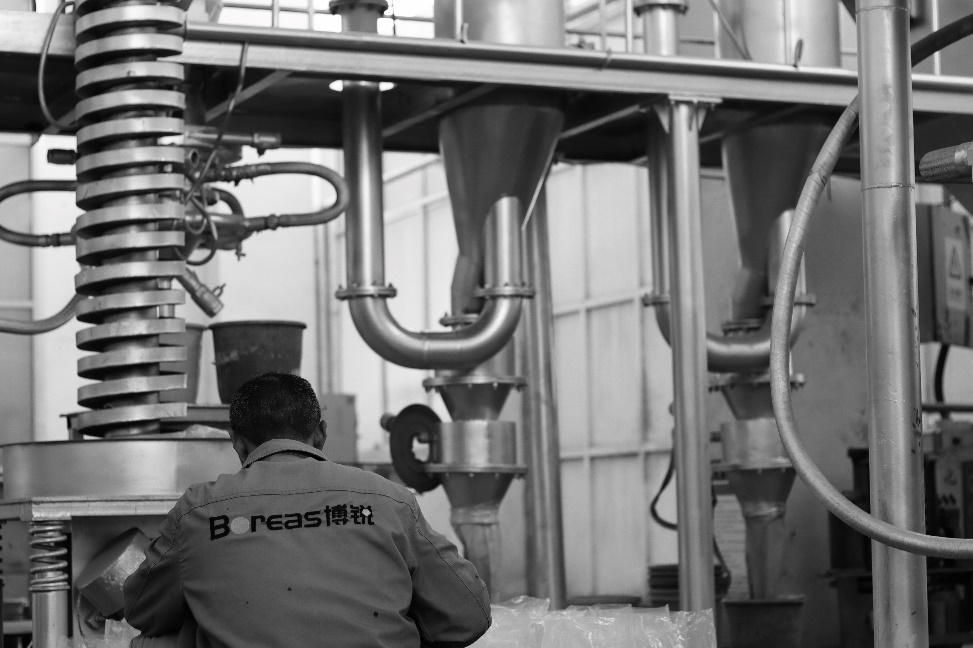
At Boreas, diamond abrasive production has been fully upgraded from traditional inefficient processing methods to a modern jet milling system, significantly improving efficiency, consistency, and product quality.
From Traditional Ball Milling to Jet Milling Technology
In the past, many Diamond Powder Manufacturers relied onball milling (mechanical grinding) to crush and refine diamond particles. However, this method has several limitations:
- Low efficiency
- Severe contamination risk from milling media
- Poor particle shape control
- Broad and unstable particle size distribution
- High energy consumption and long processing cycles
Due to these limitations, Boreas has fully replaced traditional ball milling systems with an advanced jet milling (airflow milling) process.
Jet Milling Principle: High-Energy Particle Collision
Jet milling is a high-precision crushing and shaping technology that uses compressed high-speed airflow as the driving force.
Inside the jet mill system:
- Compressed gas (air or inert gas) is accelerated through nozzles
- High-speed airflow generates intense turbulence inside the grinding chamber
- Diamond particles are suspended and accelerated within the airflow
- Particles collide with each other at extremely high velocity
- These particle-to-particle collisionscreate controlled fracture and shaping
Unlike mechanical grinding, there are no grinding media involved, which eliminates contamination and improves purity.
👉 The key mechanism is:
high-energy inter-particle collision → controlled breakage → particle shaping
This allows simultaneous crushing and morphology optimization, producing more uniform and application-ready diamond abrasives.
Crushing and Shaping: Controlling Particle Morphology
During jet milling, diamond particles undergo two key transformations:
1. Controlled Crushing
- Large particles are broken into smaller sizes
- Weak structural points are removed
- Oversized particles are eliminated
2. Morphology Optimization (Shaping)
- Sharp edges are partially refined
- Unstable fragments are removed
- More balanced particle geometry is achieved
This results in improved consistency and more predictable performance in grinding and polishing applications.
Classification: Ensuring Narrow Particle Size Distribution
After jet milling, the material enters a precise classification system to ensure strict particle size control.
Classification is essential to:
- Remove oversized particles (D90 control)
- Eliminate excessive fines
- Achieve narrow PSD (Particle Size Distribution)
- Ensure batch-to-batch stability
Advanced airflow classification systems allow Boreas to deliver diamond powders with stable D10, D50, and D90 values, which is critical for high-end applications such as:
- 3C electronics polishing
- Optical glass finishing
- Ceramic precision machining
- Semiconductor-related processing
Why Boreas Jet Milling Improves Product Performance
Compared with traditional ball milling, the Boreas jet milling process provides significant advantages:
- Higher purity (no grinding media contamination)
- Better particle uniformity
- More controlled morphology
- Narrower particle size distribution
- Improved cutting stability in end applications
- Higher efficiency and lower processing damage
This technology upgrade ensures that diamond powders perform more consistently in demanding industrial environments.
Application Impact in Industrial Fields
The improved diamond powders produced through jet milling are widely used in:
- Smartphone glass grinding and polishing
- Ceramic and sapphire processing
- Precision mold manufacturing
- Dental abrasive tools
- High-end CNC grinding systems
In all these applications, particle consistency directly determines surface quality, tool life, and process stability.
Conclusion
The manufacturing of diamond abrasives is no longer a simple crushing process. It is a highly controlled engineering system involving crushing, shaping, and classification.
By fully adopting jet milling technology, Boreas has moved beyond traditional ball milling limitations, achieving:
- More uniform particle morphology
- Higher purity levels
- Stable particle size distribution
- Improved performance consistency
In modern precision manufacturing, this level of control is essential for delivering high-performance diamond abrasives for advanced industrial applications.
